





How to Measure Pillow Insert Size: Designer Sizing Guide
Few details elevate a luxury bedroom or living salon quite like a collection of impeccably styled, plump decorative pillows. Yet even the most beautiful handcrafted upholstery fabrics can look flat, deflated, or rumpled if paired with the wrong form inside. Achieving that flawless editorial loft you see in high-fashion design showrooms depends entirely on understanding how to measure a pillow insert and choosing the perfect size for your decorative covers. When you learn how to measure pillow insert dimensions and apply a few simple styling secrets, you can transform your spaces into inviting, luxurious sanctuaries.
How to measure a pillow insert comes down to three essential steps: measuring the empty cover seam to seam. Selecting the right sizing formula for your pillow shape, and matching the fill material to your desired look. This guide covers each step in detail so you can style your home with confidence.
The Art and Science of the Perfect Pillow Fit
What is the correct way to measure a pillow insert? The golden rule is that inserts should be larger than the cover by 1 to 3 inches depending on the pillow shape, creating a plump, filled-out silhouette. To the untrained eye, a decorative pillow is a simple accent piece. However, professional interior designers view pillows as sculptural elements that introduce vital texture, dimension, and physical comfort to a room. The foundation of this sculptural beauty is the insert. If the insert is too small, your beautiful cover will sag, leaving empty droopy fabric at the corners. If it is too large, the seams can strain, warping the design and making the pillow feel hard and uninviting rather than soft and opulent.
Choosing the correct insert is not just about the external appearance of the cover but also about how the overall pillow supports you when resting. Whether styled on a daybed, an oversized sectional, or layered beautifully atop fine bed sheets, the right pillow loft provides comfortable support. For decorative pillows that double as supportive resting backdrops, learning how to measure pillow insert dimensions correctly merges beautiful styling with physical well-being.
How to Measure a Pillow Cover Correctly
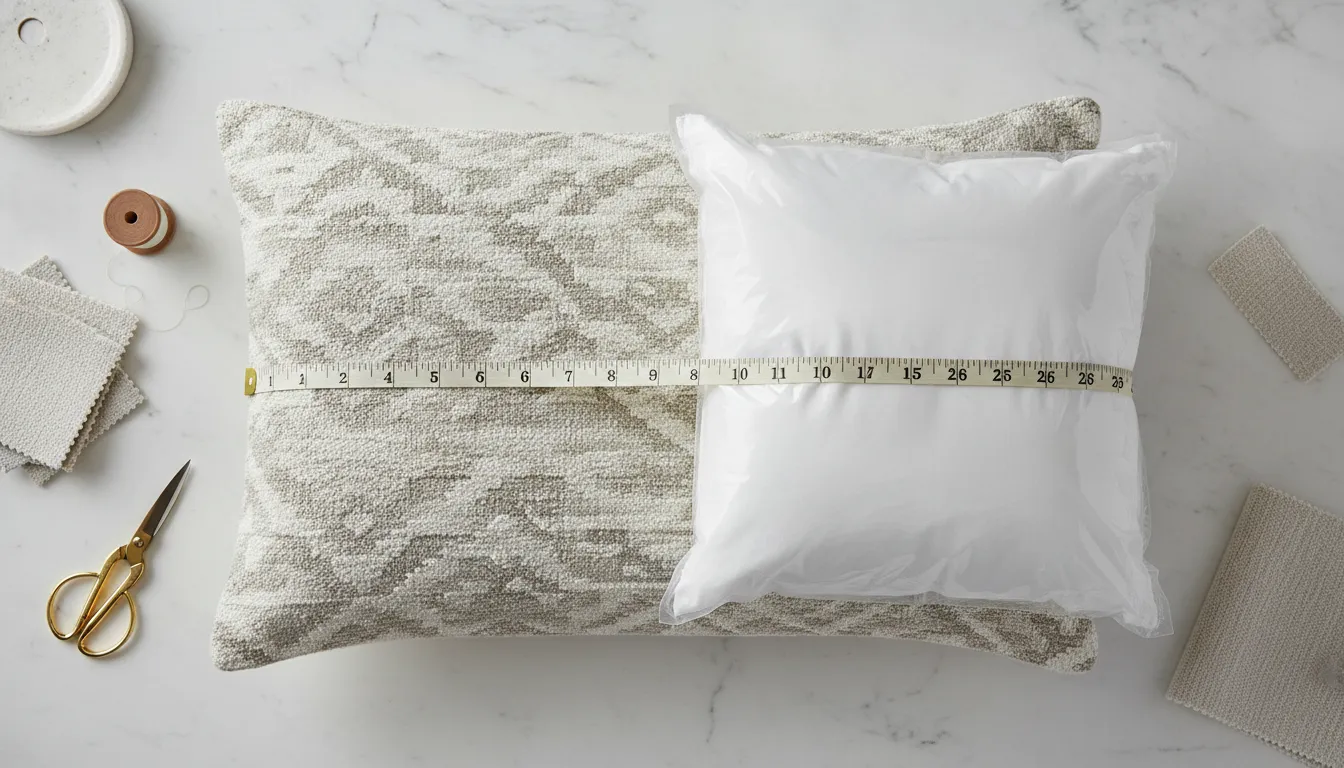
To measure a pillow insert accurately, start by measuring the empty cover. Lay the cover flat, pull the seam taut, and measure from corner seam to corner seam using a flexible sewing tape. Record both width and height. This measurement is the starting point for selecting the right insert size. Many homeowners make the mistake of measuring a stuffed pillow with a rigid yardstick or guessing the size based on visual impression. To get a precise measurement, always measure the cover while it is completely empty and lying flat.
Step-by-Step Cover Measurement Guide:
- Remove the Insert: Unzip or unbutton your decorative cover and carefully remove any existing form.
- Turn the Cover Inside Out (Optional but Recommended): For heavy upholstery fabrics or highly detailed covers with elaborate trims, turning the cover inside out allows you to see the exact stitch line.
- Lay Flat and Pull the Fabric Taut: Lay the cover on a flat, clean surface. Grasp the fabric by two adjacent corners and pull it firmly until the seam is completely straight. Do not stretch or warp the fabric, but ensure there is no slack.
- Measure Seam-to-Seam: Using a soft, flexible sewing measuring tape, measure from the inside stitch of one corner seam to the opposite corner seam. Avoid measuring diagonally across the pillow.
- Record the Dimensions: Write down both the width and the height. If a cover measures slightly off, such as 20.2 inches by 20.2 inches. Manufacturers typically round the dimensions to the nearest standard size, classifying it as a standard 20x20 inch cover. In general, high-quality decorative covers are accurate to within 0.7 inches of their specified dimensions.
How to Measure Pillow Insert Forms
If you already have pillow inserts and need to determine their size, grasp the two top corners of the insert and pull the seam taut. Align a flexible measuring tape along the edge from corner to corner. Alternatively, use the professional "girth method": wrap the tape around the widest part of the insert, pull it snug, and divide by two to get the flat size. Because inserts are filled with lofty materials like feather and down blends or synthetic fibers, they naturally curve and pull away from a flat plane. Simply laying a flat ruler across a plump stuffed insert results in an inaccurate undersized measurement.
For example, if wrapping the tape around the center of a square insert yields 44 inches. The flat size is 22 inches, meaning you have a 22x22 inch insert. This method works for any shape and is the technique professional designers use when restyling existing pillow collections. Once you know how to measure pillow insert forms this way, you can confidently pair them with new covers or shop for matching sets.
The Golden Rules of Insert Sizing
The standard rule for how to measure a pillow insert against a cover is to size up by 1 to 2 inches for square pillows. Match sizing exactly for lumbar pillows, and size up by 1 inch for small accent squares. Professional designers rely on specific sizing formulas depending on the shape and size of the pillow to achieve a high-fashion opulent look. Once you have measured your decorative pillow covers, determining the correct insert size follows these proven rules.
Rule 1: Always Size Up for Standard Squares
For standard square decorative pillow covers ranging from 18x18 inches up to 24x24 inches, always size up your insert by 2 inches. This is the absolute golden rule of professional pillow styling. Inserting a larger form into a slightly smaller cover creates a plump filled-out look, eliminating wimpy empty corners and sagging fabric.
For example, if you are styling one of our beautifully handcrafted luxury decorative pillows with a 20x20 inch cover, you should choose a 22x22 inch insert. If you have an 18x18 inch cover, pair it with a 20x20 inch insert. This simple 2-inch sizing-up method ensures that the loft of the fill pushes all the way into the corners, giving you a full inviting silhouette.
Rule 2: Adjust for Extra-Large Squares
For oversized decorative pillows, 24x24 inches and larger, the fabric cover has significantly more surface area and volume. To prevent these large statement pieces from looking flat over time, you can size up your insert by 2 to 3 inches. A 24x24 inch cover styles beautifully with a high-loft 26x26 inch insert, ensuring robust support and a striking presence at the back of your bed or sofa layering. European shams, which typically measure 26x26 inches, benefit most from the 3-inch sizing-up approach.
Rule 3: Size One-to-One for Lumbars and Rectangles
Rectangular and lumbar pillows require a different approach. Because of their narrower elongated shapes, rectangular covers do not have the same volume capacity as square pillows. If you size up a lumbar pillow by 2 inches, you risk overstuffing it, which can cause the seams to pull or prevent the zipper from closing easily. More importantly, an overstuffed lumbar pillow loses its flexible support, making it too stiff and uncomfortable to rest against.
For lumbar pillows, such as a 14x22 inch or 14x36 inch cover, choose an insert that matches the cover dimensions exactly. A 14x22 inch cover should be paired with a 14x22 inch insert. This maintains the sleek elegant profile of the rectangular design while providing the physical comfort your back needs. Why upholstery fabric makes the best pillows also plays into how the cover material handles the insert fit.
Rule 4: Scale Down for Small Accent Squares
For small petite square pillows, 14x14 inches and smaller, the fabric has very little physical volume to expand. Sizing up these small covers by 2 inches can make them excessively hard. For these small accent pillows, size up your insert by only 1 inch. For instance pairing a 12x12 inch cover with a 13x13 inch insert, or stick to a one-to-one ratio to preserve a soft elegant touch.
View the Decorative Pillow Collection
Pillow Sizing Quick-Reference Chart
To make your design process seamless, refer to this quick guide when selecting inserts for your decorative covers. This chart summarizes every sizing rule in one place so you never have to guess how to measure a pillow insert again.
| Cover Shape | Cover Flat Size | Recommended Insert Size | Sizing Formula |
|---|---|---|---|
| Small Square Accent | 10" x 10" or 12" x 12" | 11" x 11" or 13" x 13" | Size up 1 inch |
| Standard Square | 18" x 18" | 20" x 20" | Size up 2 inches |
| Medium Square | 20" x 20" or 22" x 22" | 22" x 22" or 24" x 24" | Size up 2 inches |
| Oversized Square or Euro Sham | 24" x 24" or 26" x 26" | 26" x 26" or 28" x 28" | Size up 2 to 3 inches |
| Standard Lumbar | 14" x 22" | 14" x 22" | Size matching (1-to-1) |
| Oversized Lumbar | 14" x 36" | 14" x 36" | Size matching (1-to-1) |
Choosing the Right Insert Filling Materials
The two main insert fill types are feather and down blends for structure and softness, and down alternative for hypoallergenic durability. The fill material affects not just comfort but also how the pillow drapes, holds its shape, and responds to the "karate chop" styling technique favored by interior designers. Beyond physical measurements, the composition of the filling inside your insert dictates both the tactile comfort and the overall aesthetic of your styling.
Feather and Down Blends: The Luxury Standard
For decorative pillows styled in formal sitting rooms or elegantly dressed beds, feather and down fills represent the gold standard. Feathers provide weight, structure, and excellent recovery, while down adds softness and luxurious loft. A 90% gray duck feather and 10% goose down filling ratio is highly recommended for decorative pillows because it is neither too stiff nor too soft. Offering the perfect balance of firm support and plush comfort. The primary design benefit of a feather-heavy insert is its structural flexibility. This is the fill type required if you wish to achieve the classic designer "karate chop" look. Where a gentle hand-chop to the top edge of the pillow creates an elegant stylized indentation that catches the light beautifully.
Down Alternative: The Clean Hypoallergenic Alternative
For individuals with feather sensitivities or allergies, down alternative inserts offer an outstanding solution without sacrificing the coveted plump look. Premium down alternatives are engineered to mimic the loft and density of natural down. High-quality synthetic fills, such as a blend of 50% woven cotton and 50% polyester, deliver superb resilient loft and physical support. Down alternative inserts are highly durable, easy to fluff, and keep their shape beautifully over time. While they hold their structural loft exceptionally well, they are slightly more resilient than feathers. Meaning they will resist holding a deep "karate chop" but will maintain a flawlessly smooth rounded and clean aesthetic. Browse our selection of premium pillow inserts to find the right fill for your styling needs.
Caring for Handcrafted Decorative Pillows
To preserve the beauty and longevity of your styled decorative pillows, proper care is essential. Unlike standard bedding basics, luxury decorative covers are handcrafted using premium heavy upholstery fabrics, intricate embroidery, and delicate trims. Because of these handcrafted details, decorative covers are generally not machine washable; spot cleaning is highly recommended to protect the integrity of the fibers. Our guide on how to protect handcrafted pillows from daily wear covers maintenance routines in detail.
For daily maintenance, regularly fluff and rotate your pillows to ensure the inserts distribute evenly and maintain their loft. If a spill occurs on a linen or velvet cover. Spot clean immediately with a mild solvent-free detergent and a soft damp cloth, blotting gently rather than rubbing the fabric. Taking the time to properly care for both your covers and your inserts ensures your investment in luxury home textiles continues to elevate your sanctuary for generations. For pillows that need deeper care, see our step-by-step guide on how to clean pillows you cannot put in the washer.
Frequently Asked Questions
How much bigger should a pillow insert be than the cover?
For standard square covers, size up the insert by 2 inches. For small accent squares (14x14 inches and smaller), size up by 1 inch. For oversized squares (24x24 inches and larger), size up by 2 to 3 inches. For lumbar and rectangular covers, match the insert size exactly to the cover dimensions to avoid overstuffing.
How do you measure a pillow insert size?
Grasp the two top corners of the insert and pull the seam taut. Measure from corner to corner using a flexible sewing tape. Alternatively, use the girth method: wrap the tape around the widest part of the insert, pull snug, and divide by two to determine the flat size. This is the most accurate way to measure a pillow insert that is already stuffed.
What if my decorative pillow cover has no zipper?
Covers without zippers are typically envelope-style or knife-edge designs with a side opening. Measure the cover the same way by laying it flat and pulling the seam taut. If the cover is sewn shut, it likely came with a permanent insert and is not designed for replaceable inserts. In that case, consider having a custom insert made or using the cover as a decorative accent as-is.
Can I use a down alternative insert in a cover that originally had a feather insert?
Yes. Down alternative inserts work in any cover designed for replaceable inserts. Keep in mind that down alternative fills are more resilient and hold a rounder shape, while feather fills offer more flexibility for the "karate chop" styling technique. Select the fill that matches the look you want for your space.
Why does my decorative pillow look flat even with the right insert?
A flat appearance usually means the insert needs regular fluffing, the cover is too large for the insert, or the fill material has compacted over time. Try removing the insert, giving it a thorough fluff in a dryer on no-heat for 10 minutes, and reinserting. If the cover is visibly too large, size up the insert by the appropriate rule from the sizing chart above.
Bringing Your Vision to Life
Now that you know how to measure a pillow insert and select the perfect size, you can curate your rooms with confidence. Whether you are dressing a bed in European-inspired elegance or arranging statement pillows on a classic sofa. Matching the correct insert to your beautiful covers is the key that unlocks designer-level styling. The combination of accurate sizing, premium fill materials, and proper care ensures your decorative pillows stay plump, inviting, and beautiful for years to come. Explore our collection of artisan-crafted luxury decorative pillows and discover how the perfect blend of texture, craftsmanship, and impeccable fit can elevate your home.


