





Custom Made To Order Throws: Bespoke Luxury Guide
A throw can be the final note that makes a bedroom feel considered rather than simply furnished. Custom made to order throws take that idea further by letting the textile, proportion, finish, and palette respond to the room instead of asking the room to adapt to a ready-made layer.
Custom made to order throws are decorative luxury textiles produced to a selected design direction, allowing the fabric, scale, color, and detailing to support a specific bedroom or living space.
View Custom Made-to-Order Throws
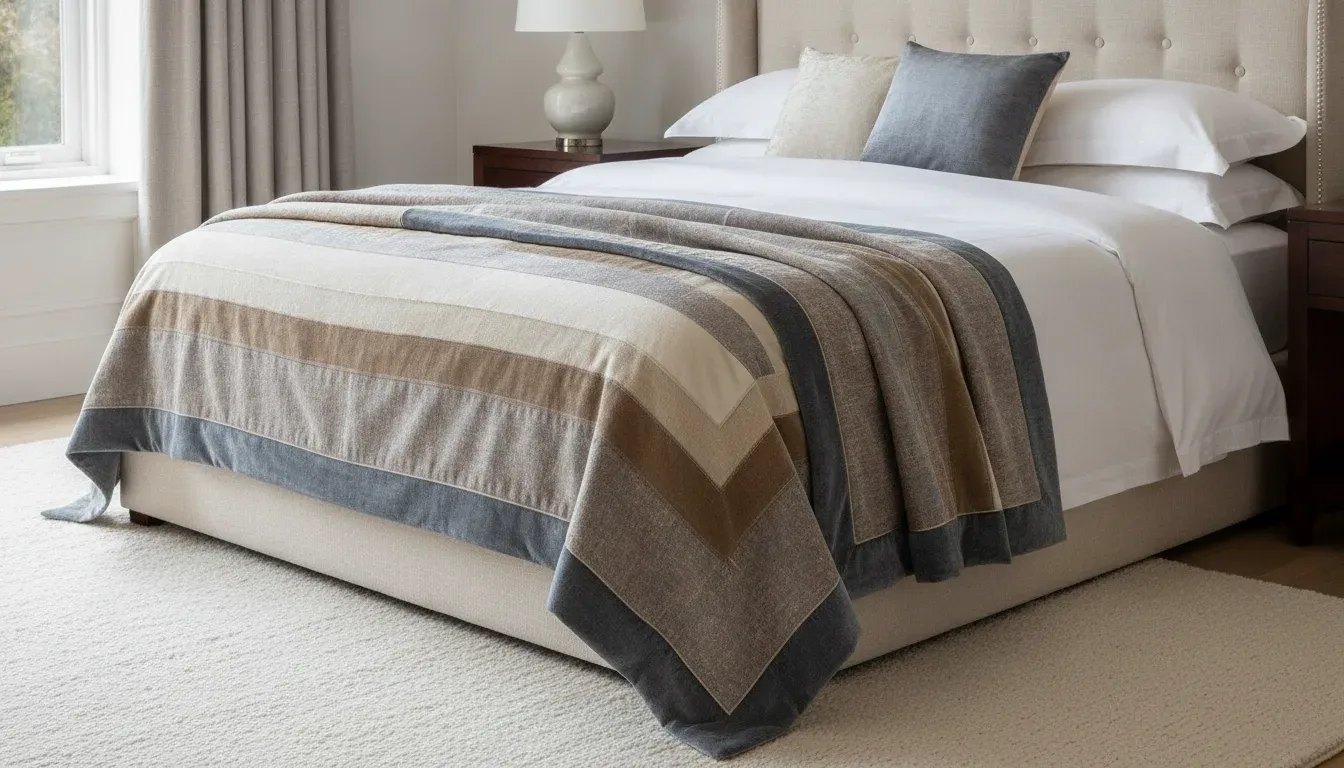
Why choose a bespoke throw for a luxury room?
A made-to-order throw is not merely an extra blanket. In a polished interior, it can introduce a deliberate contrast, echo a room's most important color, or soften a strong architectural line. Because it is selected as part of the design story, the throw can connect the bed, accent chair, chaise, and surrounding textiles with more precision.
This approach is especially useful when the room already includes distinctive bedding, a statement headboard, custom upholstery, or a carefully edited art collection. A standard accessory may be attractive on its own yet feel disconnected in the finished space. A bespoke textile gives the designer or homeowner a way to refine the relationship between surface, scale, and movement.
It also supports a more intentional view of luxury. The value is not only in softness. It is in the way a fabric catches light and a border frames the composition. It is also in the way the throw falls over a mattress or drapes over a chaise.
What can you customize in a made-to-order throw?
The most successful custom made-to-order throws begin with a clear hierarchy of decisions. Choose the visual role first, then narrow the materials and finishing details that will deliver it.
- Fabric direction: Consider textured velvet, linen, jacquard, boucle, or another suitable textile based on the desired handfeel, sheen, structure, and room use.
- Color and contrast: Decide whether the throw should blend with the bedding, repeat an accent shade, or create a restrained contrast.
- Scale: Confirm whether the piece will sit at the foot of a bed, fold over a chair, drape across a chaise, or serve as a decorative layer in a living space.
- Surface interest: Explore quilting, woven dimension, applique, piping, borders, or other handcrafted details when they suit the design direction.
- Edge treatment: A tailored edge, contrast border, or softly finished perimeter can change the visual weight of the entire piece.
- Care expectations: Match the textile and finish to the level of maintenance the room and household can support.
Lili Alessandra's Custom Made-To-Order collection presents pillows, throws, draperies, and furniture in performance fabrics including textured velvets, linens, jacquards, and boucle. That range creates room for a designer-led selection without reducing the result to a generic textile accent.
How do you select the right fabric?
Begin with the room's existing materials, not with a fabric name in isolation. A throw with a reflective surface behaves differently from a dry woven textile. A plush pile can make a minimalist room feel warmer, while a linen or woven construction may add a more relaxed counterpoint to tailored bedding.
| Fabric direction | Design effect | Questions to ask |
|---|---|---|
| Textured velvet | Depth, softness, and controlled sheen | Will the nap and light response complement nearby upholstery? |
| Linen | Relaxed texture with an understated finish | Should the throw soften formal bedding or reinforce a natural palette? |
| Jacquard | Pattern, structure, and woven detail | Does the scale support the room without competing with the headboard or art? |
| Boucle | Tactile dimension and a softly sculptural surface | Will the texture add contrast while remaining easy to style? |
For a broader discussion of handfeel, proportion, weight, and visual integration, read Lili Alessandra's guide to choosing a luxury throw blanket. A custom brief should build on that foundation by defining what the throw needs to do in this particular room.
How should the throw's size and proportion be planned?
Proportion is one of the most important reasons to consider made-to-order design. A throw that is too small can look incidental on a large bed. One that is too generous may overwhelm a chair or create more visual volume than the room needs.
Measure the intended placement before selecting a finished dimension. For a bed, note the width of the mattress, the depth of the footboard if there is one, and the amount of drop you want at each side. For a chaise or chair, measure the surface that should be covered and decide whether the throw will be folded, casually draped, or arranged as a sculptural accent.
Many of Lili Alessandra's ready-to-shop throws use elongated proportions suited to the foot of a bed or a long upholstered seat. The Florus Pebble Woven Chenille Luxe Padded Throw, for example, is listed at 25 by 98 inches and is described as custom made to order. It offers a useful reference for thinking about a narrow, elongated decorative layer rather than a wrap-style blanket.
When planning a custom piece, specify the visual endpoint as well as the measurement. "A tailored band across the foot of the bed" communicates the intended drape more clearly than a dimension alone.
What is the made-to-order process?
A thoughtful process turns a beautiful idea into a piece that works in the room. While the exact workflow depends on the design and product, these stages help organize the conversation:
- Define the setting. Identify the room, placement, neighboring textiles, desired mood, and practical use.
- Review fabric directions. Compare texture, color, scale, sheen, and performance rather than choosing from a screen image alone.
- Confirm dimensions and finish. Establish the size, edge treatment, quilting or woven detail, and any contrast elements.
- Check care and availability. Confirm the care method, production timing, return terms, and any material-specific requirements before ordering.
- Place the order. Once the specifications are approved, the piece moves into production according to the maker's process.
- Plan the room installation. Decide how the finished throw will be folded, draped, or layered so it arrives with a clear role.
Current product information for the Florus made-to-order throw states that delivery should be allowed about four weeks and that the item is not returnable. These details illustrate why lead time and terms belong in the design conversation before an order is placed. Verify the current product page for the specific piece because timing, care, and return conditions can vary.
For trade projects, the Lili Alessandra To The Trade Program can provide a more structured path for professional sourcing, including a dedicated sales consultant and textile support. Interior designers should confirm current program details directly when planning a client installation.
How do you coordinate a bespoke throw with bedding?
Coordination does not require every textile to match. It requires the room to have a visual conversation. A custom throw can repeat one color from the bedding while introducing a different texture, or it can act as a quiet bridge between the bed and an upholstered chair.
Use the bedding as the architectural foundation. The Bedding collection can help establish the main palette and layering direction. From there, decide whether the throw should reinforce the bed's dominant tone or provide a controlled point of contrast.
Coverlets and duvet covers also affect the amount of visual information in the room. If the bed already includes pattern or dimensional quilting, a calm solid throw may provide balance. If the bedding is restrained, a more expressive woven or velvet surface may become the room's finishing gesture. Lili Alessandra's Coverlets collection and guides to what a coverlet is and queen quilts and coverlets offer useful context for building that layered foundation.
Keep the number of competing statements under control. If the headboard, coverlet, pillows, and throw all have a bold motif, the eye may lose the sense of hierarchy that makes a luxury room feel composed.
How can texture make a throw feel bespoke?
Texture communicates quality before a visitor notices every construction detail. It creates shadow, movement, and touch, which is why a well-chosen throw can make a room feel more dimensional without adding more furniture.
Layer texture across different distances. At the farthest view, the throw should contribute to the room's silhouette and palette. At the middle distance, its proportion and edge should support the bed or chair. Up close, the handfeel, weave, pile, quilting, and finish should reward attention.
Velvet can bring depth and a softly directional surface. Woven chenille can add tactile structure. Linen can temper a formal composition with a more relaxed note. A jacquard can introduce pattern through the construction of the cloth rather than through a flat printed image. These are design tools, not a checklist. Select the combination that supports the room's purpose.
For nearby accents, explore Lili Alessandra's guides to luxury velvet throw pillows and styling velvet accent pillows. The throw should complement those pieces while preserving a clear focal point.
What should you confirm before ordering?
Made-to-order design rewards preparation. Before approving a fabric or dimension, collect the details that affect both appearance and ownership.
- Placement: Photograph or measure the bed, chair, chaise, or other destination so the scale can be judged in context.
- Palette: Compare fabric samples with the bedding, upholstery, flooring, and lighting at different times of day.
- Care: Ask whether the finished textile is washable, spot clean only, or professional dry clean only. Follow the specific product instructions rather than assuming all throws share the same care method.
- Lead time: Build production time into the room schedule, especially for a trade installation or a seasonal project.
- Return terms: Confirm whether the item is non-returnable because it is produced to order.
- Final use: Decide whether the throw is primarily decorative, an occasional comfort layer, or both.
The Federal Trade Commission's Care Labeling Rule summary explains the importance of clear, accurate care instructions for covered textile goods. For a home textile, the practical takeaway is simple: treat care information as part of the purchase decision, not as an afterthought.
Lili Alessandra's Throws collection provides a useful way to compare existing silhouettes, materials, and proportions before discussing a custom direction. The velvet pillows collection can also help establish how a plush accent should relate to the throw without making the entire room feel heavy.
How should a bespoke throw be styled after it arrives?
Start with one confident arrangement. At the foot of a bed, fold the throw into a clean band if the room is tailored, or let one edge fall naturally if the space benefits from relaxed movement. On a chair or chaise, place the throw where it looks intentional but remains easy to lift and use.
Avoid spreading a decorative throw so flat that it loses its texture. A soft fold or controlled drape lets the surface catch light and makes the piece feel connected to the room rather than displayed like a sample. Keep the strongest visual detail facing the area where it can be appreciated.
Balance the throw with the pillow arrangement. If the throw carries a rich texture or pattern, allow the pillows to support it with quieter surfaces. If the throw is a calm neutral, a small amount of pillow contrast can create a more layered composition. The goal is not maximal decoration. It is a room where every layer appears to have been selected for a reason.
For additional layering ideas, connect the throw to guidance on styling decorative pillows like an interior designer and the velvet duvet cover guide. A custom throw should complete the arrangement, not compete with the bed's main envelope.
Connect with a Lili Alessandra Design Advisor
Frequently asked questions
What are custom made to order throws?
They are decorative throws produced to a selected design direction, with the fabric, proportions, color, and finish chosen to suit a particular room.
How long does a made-to-order throw take?
Timing depends on the specific design and current production schedule. One current Lili Alessandra made-to-order throw states that customers should allow about four weeks. Confirm timing for the selected piece before ordering.
Can I choose the fabric for a custom throw?
The made-to-order collection presents a range of performance fabric directions, including textured velvets, linens, jacquards, and boucle. Ask a design advisor which options are available for the specific throw and finish you are considering.
Are made-to-order throws returnable?
Return terms vary by product, and current product information may identify a made-to-order item as non-returnable. Review the specific product page and policies before approving the order.
Where should a luxury throw be placed?
Use it at the foot of a bed, across a chaise, or over an accent chair. Choose the placement that gives the throw enough surface area to show its proportion and texture without overcrowding the room.
How do I care for a bespoke throw?
Follow the care instructions for the exact textile and construction. Some decorative throws may require professional dry cleaning, while others may have different instructions. Never assume that one throw's care method applies to another.
A bespoke throw is most successful when it feels inevitable in the finished room: personal, tactile, and precisely proportioned. Start with the room's needs, confirm the textile and timing, and let the final layer bring the entire composition into focus.


