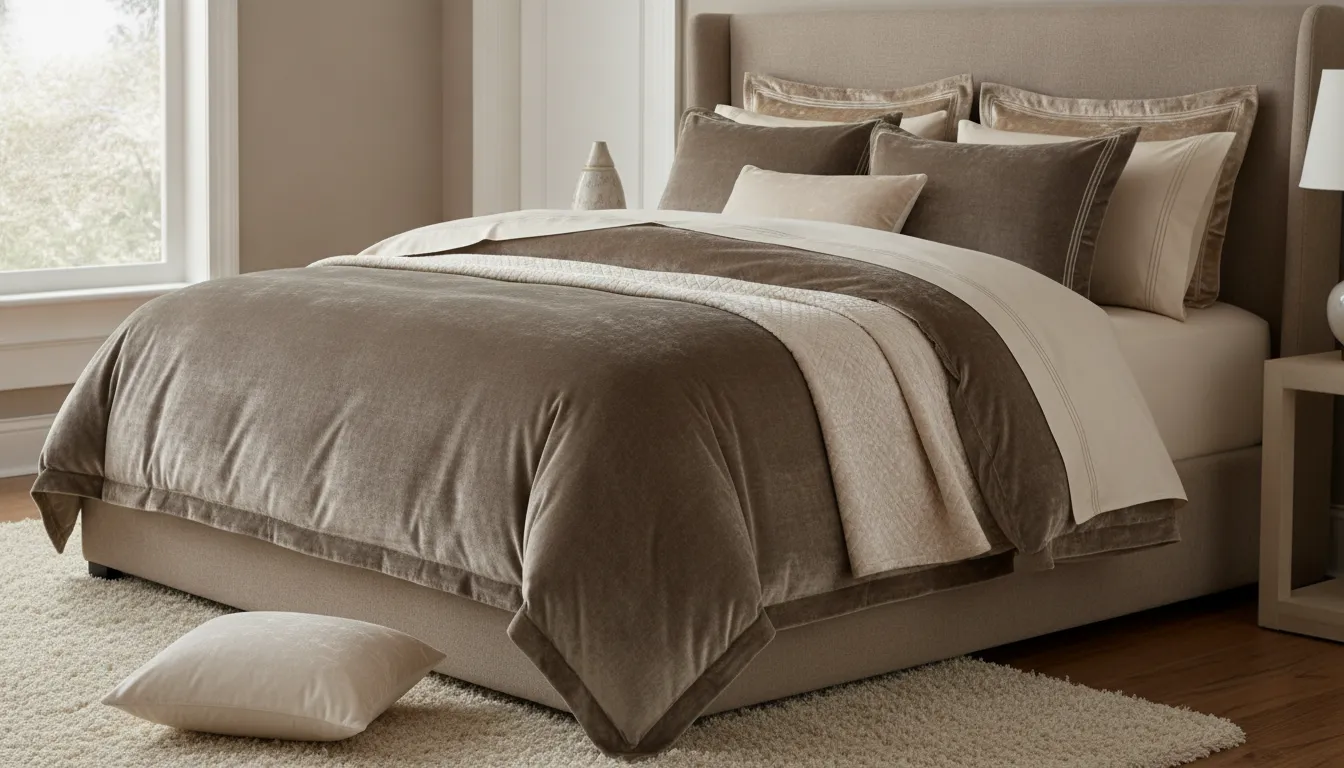





King Size Crushed Velvet Duvet Cover Guide
A king bed gives velvet room to make an impression. Its generous scale also makes proportion impossible to ignore. The right cover should drape intentionally, feel inviting against the light, and support the layered look you want. It should not swallow the mattress or compete with the room.
Choosing a king size crushed velvet duvet cover starts with checking the cover's stated dimensions, matching the insert to its construction, and considering how the velvet's pile, sheen, and color will read in changing light. Since duvet covers do not include inserts, confirm both pieces separately before ordering.
From silver and ivory to champagne, taupe, and softer grey, a considered palette can make crushed velvet feel polished rather than overwhelming. Begin with the practical question of proportion, then refine the tactile and visual details that turn a beautifully made cover into a composed bedroom centerpiece.
How to Check the Fit of a King Size Crushed Velvet Duvet Cover
A beautiful king duvet cover should fall with intention, not simply fit by label. Before choosing a king size crushed velvet duvet cover, measure the bed it will dress and compare those measurements with the exact product listing. Mattress depth, frame height, topper thickness, and the amount of side coverage you prefer all affect the finished silhouette.
Measure the bed, not just the mattress label
Start with the mattress width, length, and depth. If you use a mattress topper, include it in the depth measurement. Then measure from the top of the mattress to the point where you want the cover to finish. A low platform frame and a tall upholstered bed can create very different visual proportions, even when both hold a king mattress.
- Record the mattress width and length.
- Measure total depth, including any topper.
- Measure the desired drop on each side and at the foot.
- Note whether the frame, footboard, or side rails will limit the drape.
Do not assume that every king-size cover uses one universal measurement. Compare the finished cover dimensions with your measurements and decide whether you want a tailored edge, a generous drop, or a more layered, relaxed appearance. For example, the Versailles silver and ivory king duvet is listed at 112 by 98 inches. That is a product-specific measurement, not a standard to apply to every king cover.
Confirm the cover construction and closure
Review the product page for the opening and closure before ordering. Check whether the closure arrangement will work with the way you insert, remove, and launder the cover. Also look for the finished dimensions, material details, and care directions. With crushed velvet, the closure and seams can influence how smoothly the cover settles across the bed. These practical details deserve the same attention as the color and sheen.
Match the insert to the cover
Lili Alessandra duvet covers do not include inserts. Oversized duvet inserts are sold separately, so confirm that the insert you plan to use is compatible with the specific cover before purchase. An insert that is too small may leave the corners and center looking flat. One that is too large can create excess bulk and obscure the cover's drape.
Use the duvet insert guide and insert sizing guide when comparing dimensions, then verify the final recommendation on the product page. The luxury duvet cover collection is a useful starting point, but each listing remains the authority for its own measurements and inclusions. Taking these steps first lets the velvet's texture and decorative detail become the focus, rather than an awkward drop or uneven fill.
What Makes Crushed Velvet Look So Dimensional?
Crushed velvet gets its depth from the way its surface changes direction. Velvet is built around a raised pile, and the pile's length, density, and construction influence how it responds to use, touch, and cleaning. In a crushed finish, that directional variation creates a field of shifting highlights and shadows rather than one uniform sheen. The effect is richly tactile, but it is also why the same duvet can look different from one angle, or even across one photograph.
Think of the pile as a very short landscape. When it leans toward the light, it can appear luminous. When it turns away, the surface reads deeper and more shaded. The Smithsonian's explanation of velvet pile and light reflection notes that flattened pile changes the way light reflects from the fabric. That principle helps explain both the appeal and the care considerations of crushed velvet. Pressure, moisture, and stains can alter the pile, sometimes leaving a lasting change in the finish.
Crushed velvet compared with matte velvet
Crushed velvet is intentionally expressive. Its irregular nap produces movement, shimmer, and a more dramatic response to bedroom lighting. Matte velvet is quieter. Its surface tends to present a more even, restrained appearance, making color and silhouette the leading design elements. Neither finish is inherently more luxurious. The right choice depends on whether the bed should act as a focal point or provide a calm foundation for other layers.
For a softer, understated direction, Lili Alessandra's ivory and fawn velvet duvet uses matte velvet in a tonal palette. By contrast, a crushed velvet duvet can bring more visual movement without requiring a busy pattern. Explore the broader luxury velvet bedding guide when comparing the finish with coordinating textures.
How to inspect texture in product photography
Start with a lifestyle image. Look for areas where the fabric catches light, then compare them with shaded folds. Detail photography is especially useful for reading pile direction, surface variation, decorative edges, and scale. A close-up can reveal whether the finish appears softly mottled or sharply reflective, while a room image shows how that character behaves beside sheets, coverlets, and pillows.
Do not use photography to infer fiber content. Crushed velvet describes a surface treatment and visual finish, not a guaranteed material composition. Lili Alessandra's Enzo collection, for example, is specifically identified with signature silk velvet, but that fact should not be transferred to every velvet design. Let the individual product listing establish its materials and care guidance, then use the imagery to judge the dimension, hand feel, and atmosphere you want.
Which Color Works Best in a Luxury Bedroom?
Color should respond to the room that already exists. Consider the undertones in your walls, flooring, upholstery, and window treatments before choosing a velvet duvet. Then decide whether you want the bed to settle into the palette or become its most compelling focal point. A thoughtful color choice gives crushed velvet room to show its dimension without making the bedroom feel visually crowded.
Warm palettes
Warm bedrooms benefit from hues that echo their existing softness. Taupe, fawn, champagne, ivory, and muted gold can create a composed, enveloping atmosphere when paired with warm wood, cream upholstery, or softly tinted walls. The taupe and fawn king duvet is a natural reference for this direction. For a more decorative interpretation, the champagne velvet king duvet introduces an ivory velvet applique that adds definition while remaining within a warm, refined range.
Cool and tonal palettes
Silver, light grey, moonstone, and muted grey create a quieter, cooler bedroom. These colors work especially well with pale stone, blue-grey, charcoal, or crisp ivory accents. The Enzo collection includes the sophisticated Moonstone colorway in Lili Alessandra signature silk velvet, offering a tactile reference for a tonal scheme. Because silk velvet requires specialized care, review the individual product guidance before purchase. For a softer contrast, explore the light grey velvet king duvet, which pairs matte velvet with a decorative gold print.
Contrast without competition
Contrast is most successful when one element leads and the others support it. A dramatic duvet can be grounded with quiet sheets and a restrained coverlet, while a neutral duvet can carry stronger decorative pillows or a sculptural throw. The luxury bedding collections make it easier to consider coordinated duvets, shams, coverlets, and decorative elements together. You can also compare the understated ivory and fawn combination in the Soho duvet when you want tonal depth rather than a high-contrast statement.
Use the bed's scale as part of the decision. On a generous surface, a pale neutral may read as airy and expansive, while a deeper or warmer shade can make the bed feel more anchored. Keep the supporting layers close in value when the duvet has a strong sheen or decorative detail. If the room is already layered with pattern, a tonal velvet lets the architecture and furnishings remain visible.
Color is consequential in a large king bed, and screen images cannot fully convey velvet's changing surface. Request swatches before committing, particularly when matching upholstery, paint, or heirloom furnishings. The complimentary Design Concierge can provide personalized recommendations and swatches to help you assess the color in your own setting.
How Should You Layer Velvet Without Overloading the Bed?
A crushed velvet duvet should establish the bed's focal point, not compete with every other textile in the room. The most polished arrangement builds from a quiet foundation, adds one supporting layer with a distinct role, then reserves the strongest pattern or contrast for a small number of decorative pillows. Lili Alessandra's coordinated bedding ensembles bring together duvets, shams, coverlets, and decorative elements, making it easier to create cohesion without making every piece identical.
For a king bed, begin with smooth sheets in a restrained neutral or a shade drawn from the duvet. Place the crushed velvet duvet over the insert and allow its changing pile to provide the principal depth. Then add a coverlet only where it improves the composition, such as folded across the lower third rather than spread over the entire duvet. This preserves the velvet as the visual lead.
| Layer | Purpose | Styling direction |
|---|---|---|
| Sheets | Create a calm foundation | Choose a smooth, quiet color that lets the velvet stand forward. |
| Crushed velvet duvet | Anchor the composition | Keep this as the focal layer. Let its sheen and pile carry the texture. |
| Coverlet | Add tailored structure | Fold it at the foot of the bed instead of covering the duvet completely. |
| Shams | Frame the sleeping area | Coordinate with the duvet or coverlet, then vary scale through the pillows. |
| Decorative pillows | Introduce personality | Use a considered mix of shape, color, and pattern. Stop before the arrangement feels crowded. |
| Throw | Finish with softness | Drape one throw casually at the foot or over a corner, keeping its texture distinct from the velvet. |
The key is contrast by function. Smooth sheets balance the tactile surface. A quilted or woven coverlet contributes structure rather than another competing sheen. Decorative pillows can supply pattern, but they should repeat a color already present in the room or duvet. The designer pillow styling guide can help refine scale and placement, while the coverlet layering guide offers ideas for a more tailored lower fold.
Pay attention to what the eye sees from the doorway. If the duvet already has a pronounced crushed effect, keep the surrounding palette composed and let the bed's silhouette remain clear. Texture should create dimension, not visual noise. This is especially important when the room includes patterned drapery, an upholstered headboard, or a richly finished rug.
Use the decorative pillows collection and luxury throws selectively. A single repeated finish is often more elegant than several unrelated textures. Lili Alessandra's Complete the Look suggestions can also help coordinate color and proportion. For additional direction, explore this professional bed layering approach before adding another piece. The finished bed should feel dimensional, inviting, and edited, with the crushed velvet duvet remaining unmistakably at the center.
How Do You Care for Crushed Velvet Bedding?
Crushed velvet rewards thoughtful handling. Its changing sheen comes from the direction and condition of the pile, so care should preserve the surface rather than force it into a uniform finish. The Smithsonian notes that pile length, density, and construction affect how velvet responds to use and cleaning. Because flattened pile can change the way light reflects across the fabric, read the care label and the individual product page before choosing any washing or cleaning method.
Begin with gentle, dry maintenance
For routine dust removal, use a vacuum with a soft upholstery attachment and a light touch. Regular vacuuming helps remove soil before it works deeper into fibers and padding, according to guidance from the University of Nebraska Extension. Avoid stiff fiber brushes and metal brushes, which may damage the fabric. If the pile has a visible direction, work carefully and follow the surface rather than aggressively brushing against it.
Air the bedding occasionally in a dry, shaded room, leaving enough space for air to circulate. Avoid placing crushed velvet in direct, intense sunlight for extended periods, especially when the fabric has a rich or delicate color. Moisture can flatten and permanently distort velvet pile or affect its finish, so do not use steam, saturating sprays, or a damp cloth as a general refresh unless the care directions specifically allow it.
Respond to spills without spreading the stain
Act promptly when a spill occurs. Blot the area with a clean, dry, absorbent cloth. Do not rub, scrub, or press the liquid outward across the pile. The Nebraska guide advises removing spots immediately because they become harder to remove over time. The Smithsonian also cautions that stains can mat or distort velvet pile permanently. Test any approved cleaning solution on an inconspicuous area first, and stop if the color, nap, or sheen changes.
Never assume that a king size crushed velvet duvet cover is machine washable. Velvet types can respond differently to wear and care procedures, and the construction of a cover matters as much as its surface. If the label calls for professional cleaning, use a cleaner experienced with velvet and describe the fabric, finish, and any decorative details. Avoid removing a cover for separate cleaning when the instructions do not recommend it. Mechanical action can cause a cover to shrink, distort, or develop frayed seams, as the University of Nebraska Extension explains.
Store it with the pile protected
Before storage, make sure the cover is completely clean and dry. Fold it loosely along natural lines, place it in a breathable protective bag, and keep it in a cool, dry cabinet away from pressure, sharp edges, and moisture. Avoid compressing it beneath heavy linens, which can flatten the pile. For broader guidance on caring for premium textiles, explore Lili Alessandra's luxury bedding care resource. Keep the sheets in your regular laundering routine: the Cleveland Clinic reports that medical experts advise washing sheets at least weekly, while blankets and pillows generally require less frequent cleaning.
When Is a King Velvet Duvet Cover the Right Choice?
A king velvet duvet cover is the right choice when the bed is meant to be a deliberate focal point, not simply a place to add another layer. Crushed velvet brings movement, sheen, and a richly tactile surface that can make a generous bed feel finished with relatively few decorative elements. It is especially compelling in a bedroom that balances classic furnishings with modern restraint, where the cover can supply dimension without competing with every object in the room.
Begin with the room rather than the trend. If the palette already includes polished stone, lacquer, glass, or smooth sateen, the shifting surface of crushed velvet introduces welcome softness. If the room is already dense with pattern and ornament, a quieter velvet treatment may create a more composed result. For a broader discussion of proportion, texture, and coordinating pieces, see this designer duvet cover guide. For a contrasting natural texture, explore this European linen bedding guide. Readers comparing crushed and crinkle finishes may also benefit from the crinkle velvet duvet styling guide, but this article remains focused on the king-size crushed-velvet decision.
Choose the cover when these details align
- The scale is confirmed. Read the individual listing for finished dimensions, then compare them with the mattress, frame, desired drop, and insert. Do not rely on the word "king" alone.
- The insert is compatible. Duvet covers do not include inserts, and oversized inserts are sold separately. Confirm the cover and insert dimensions before ordering through the luxury duvet cover collection.
- The surface suits the room. Crushed velvet is expressive. It rewards tonal bedding, considered lighting, and a restrained supporting cast of shams, coverlets, and pillows.
- You are prepared to verify the textile. Construction, finish, and care can vary. Check the product page for the specific fabric and instructions rather than applying a general velvet rule.
For shoppers who want a reference point. The Versailles listing identifies a silver and ivory king velvet cover at 112 by 98 inches and notes that it is sold without an insert. That specification belongs to Versailles, not to every king cover. Other designs may shift the balance through applique, contrast, or a different velvet treatment. Review the luxury bedding collections with the intended sheets and coverlet in mind, then use the To The Trade Program when sourcing for a professional project.
When the exact proportion, finish, and palette are not available in a standard listing, made-to-order services may support size customization, fabric selection, or personalization. Verify that possibility for the specific product before treating it as an option. The complimentary Design Concierge can help with recommendations and fabric swatches, making a tactile decision more considered.
Practical buyer checklist
- Confirm the finished cover dimensions on the product page.
- Measure the mattress and account for the desired side drop.
- Match the insert to the cover, since it is purchased separately.
- Assess crushed velvet beside the room's existing texture and light.
- Read the product-specific care directions before purchase.
- Use a broad velvet guide for general inspiration, but return here for the king-size crushed-velvet fit and finish decision.
Connect with a Lili Alessandra Design Advisor
Frequently Asked Questions
What size insert should I use with a king duvet cover?
Start with the exact finished dimensions listed for the cover, then confirm the insert recommendations on the product page. Lili Alessandra duvet covers do not include inserts, and oversized inserts are sold separately, so the word king alone is not enough to guarantee the desired fullness. A properly compatible insert should fill the corners without creating excessive strain at the closures.
Does crushed velvet show marks or changes in texture?
Yes. The direction and density of the pile influence how crushed velvet reflects light, so folds, handling, and pressure can create visible shifts in sheen. These variations are part of the fabric's dimensional character, but flattened pile can change light reflectance. Review detail photography from several angles when comparing color and texture.
How should I clean a crushed velvet duvet cover?
Follow the specific care label or product instructions before using water, detergent, or mechanical cleaning. Remove spills promptly, since stains can mat or distort velvet pile, and use a gentle vacuuming method rather than a stiff fiber or metal brush. Moisture may permanently flatten or distort pile, so professional textile care can be the safer choice when the label does not permit home cleaning. Sources: Smithsonian textile guidance and University of Nebraska extension guidance.
How can I layer velvet without making the bed feel overly heavy?
Let the velvet duvet cover provide the principal visual statement, then balance it with quieter sheets, a tailored coverlet, coordinated shams, and a small number of decorative pillows. Finish with a throw placed at the foot of the bed rather than adding texture at every layer. A restrained palette and varied scale preserve the sense of dimension while keeping the ensemble composed.
How can I choose between warm and cool velvet colors?
Use the room's existing flooring, upholstery, wall color, and metal finishes as your starting point. Champagne, taupe, and fawn can soften a warm scheme, while silver, ivory, light grey, Moonstone, and muted grey can support a cooler or more tonal bedroom. When the choice is close, compare swatches or consult a Design Advisor, especially because velvet's pile can alter the way color appears across the surface.
Get Started With a More Considered Bedroom
The right velvet duvet cover brings texture, proportion, and color together with greater confidence. If you would like a second perspective on your king bedding selection, fabric direction, or overall layering, a Lili Alessandra Design Advisor can offer complimentary guidance and fabric swatches.